
How-To Guide
How to Find Web Design Clients for Your Agency
The most reliable way to find web design clients is to search for local businesses that need a better website — specifically businesses with no website, outdated websites, or weak web presence that puts them at a competitive disadvantage in local search. The problem with generic web design outreach is that it pitches businesses regardless of whether they have an actual need, resulting in low response rates and wasted effort. Targeting businesses with a specific, identifiable gap changes the dynamic: you have a concrete reason to reach out, a pitch that connects to their situation, and a service that addresses a visible problem rather than a hypothetical one. LocaMapHQ helps agencies do this systematically by city and industry, so you can build a targeted prospect list of businesses with a clear, pitch-able web presence gap rather than sending generic cold outreach into the dark. This approach does not guarantee clients — results depend on targeting, outreach quality, market conditions, and timing — but it gives your outreach a much stronger foundation than untargeted campaigns.
Why generic web design outreach fails
- Cold emailing random businesses without knowing whether they need a website produces low response rates and burns time on prospects who have no interest in the service being offered.
- Without targeting by opportunity signal, you frequently pitch businesses that already have good websites — your offer is irrelevant and easy to ignore, which trains you to expect low response rates regardless of your pitch quality.
- Manual research through Google Maps is time-consuming and inconsistent across different team members, making it difficult to build a repeatable prospecting process that scales with your agency.
- Without a structured list and workflow, prospecting becomes ad hoc — happening only when the pipeline is empty rather than running consistently as a business development habit.
- Generic outreach lacks the specificity needed to cut through the volume of cold contact local business owners receive. Relevant, targeted outreach stands out; irrelevant outreach gets deleted.
- Prospecting without industry focus makes it impossible to build the niche credibility and portfolio that help close deals faster in a specific vertical.
The manual method: Google Maps research
- 1Open Google Maps and type a specific business type and city into the search bar — for example, 'plumbers in Calgary' or 'restaurants in Austin'. Browse the results panel and note the total number of businesses shown for that search.
- 2Click each listing to view details and look for a website link. If a listing has no website link, record this business as a no-website prospect with the business name, phone number, and address copied to your spreadsheet.
- 3If a listing does have a website, open it in a separate tab and evaluate it from the perspective of a potential customer: Is the site mobile-friendly when viewed on a phone? Does it load quickly? Does it have service pages, contact information, and a visible call to action? Note the quality level in your spreadsheet.
- 4After checking each listing, return to the results panel and move to the next business. Build a rhythm — the goal is to review as many businesses as possible during a session without spending more than 2–3 minutes per listing during this initial pass.
- 5After reviewing 20–30 businesses, sort your spreadsheet by opportunity level. No-website businesses go to tier 1 (highest priority). Businesses with clearly outdated or non-mobile-friendly sites go to tier 2. Businesses with functional but mediocre sites go to tier 3 for lower-priority follow-up.
- 6For tier 1 and tier 2 prospects, do a quick secondary check: search the business name in Google to confirm your assessment of their web presence, look for the owner's name, and check whether they are active on social media. This gives you personalization material for outreach.
- 7Write a draft outreach message for each tier that references the specific gap you found. Tier 1 messages reference the missing website directly. Tier 2 messages reference the specific issue observed on the existing site.
- 8Send outreach starting with your tier 1 list before expanding. Track which messages get responses so you can refine your pitch for future campaigns.
A faster approach with LocaMapHQ
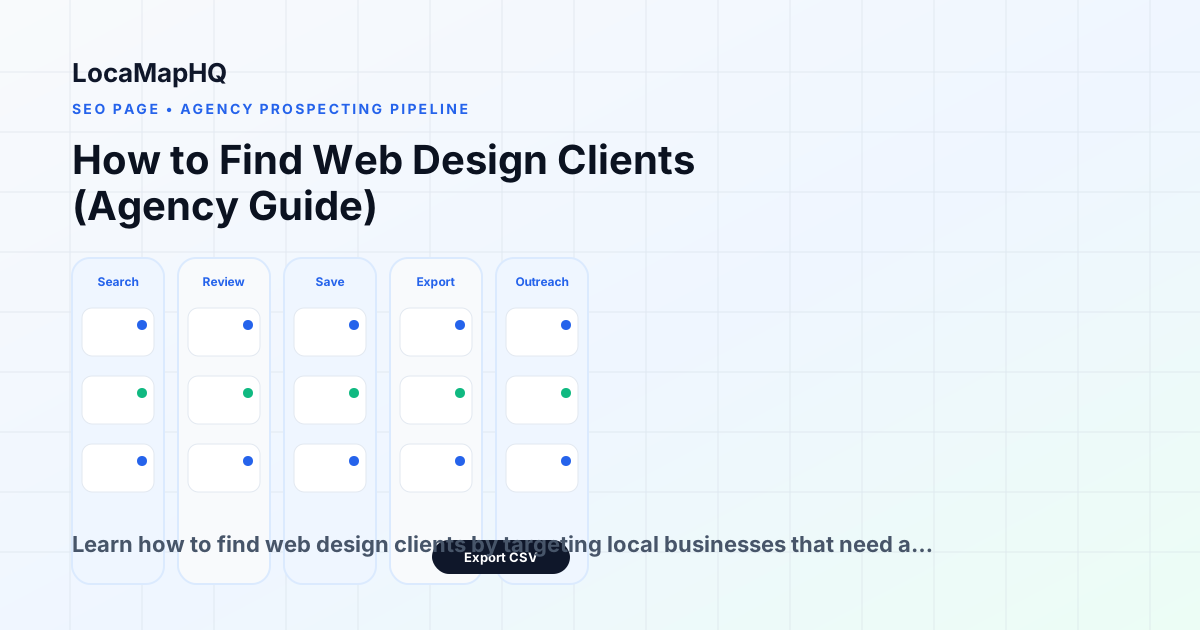
- 1Sign up for LocaMapHQ and go to the search dashboard. Enter a target city and industry — 'HVAC companies in Phoenix' or 'dentists in Tampa' — and review the structured results with opportunity signals already displayed per business.
- 2Identify no-website and bad-website flagged businesses in the results without clicking into each individual listing. Review counts are also visible per business, giving you an additional qualification signal without extra research.
- 3Save the prospects with the strongest opportunity signals — typically no-website businesses first, then weak-website businesses — inside LocaMapHQ. You can save from multiple searches and keep each city and industry campaign organized separately.
- 4Export a clean CSV of your saved prospects and begin outreach with city and industry-specific pitches. Each record includes the business details you need without additional data cleaning.
- 5Run the same search in a new city or industry to expand your prospecting without starting your research workflow from scratch. The consistent data format means your outreach templates carry over between campaigns.
Who this is for
- Web design agencies looking to add outbound prospecting to their client acquisition strategy — particularly agencies that currently rely primarily on referrals and want to build a more predictable pipeline.
- Freelance web designers building a consistent local business client base in a specific city or niche, who need a structured way to identify prospects without spending their limited business development time on manual research.
- Digital agency teams running city-specific web design campaigns where multiple team members need to prospect consistently, and where research quality needs to be consistent across the team.
- Outbound consultants who sell website builds to local contractors, restaurants, or healthcare providers and need a repeatable prospecting workflow that can be scaled across multiple markets.
- Agencies that want to move beyond referrals and build a predictable lead generation process that runs on a schedule rather than only when the pipeline runs dry.
- Studio owners who need to do business development in the gaps between client projects and want prospecting to produce a usable list quickly rather than requiring hours of manual work.
How LocaMapHQ helps
Target businesses that actually need a website — no more pitching businesses with strong web presence where your offer has no relevance to their situation.
Search any city and industry to find markets with the most opportunity for your specific service and portfolio niche.
No-website detection and weak-website signals built into search results — no manual checking required for the initial identification step.
Save and export prospects for a clean, organized outreach campaign that does not require a custom spreadsheet setup for every prospecting session.
Build a repeatable prospecting process your team can run consistently across multiple cities and industries without variation in research quality.
Find specific niches where you have case studies or relevant experience, so your outreach can reference genuine proof of results in the same industry.
Web design client prospecting checklist
- Define your target niche: which industry and city combination gives you the best match between your existing portfolio and the volume of businesses with web presence gaps?
- Confirm no-website or weak-website signal: do a Google search of the business name before outreach to verify your assessment of their web presence.
- Identify the decision-maker: for local businesses, this is almost always the owner. Find the owner's name through the business listing, their social media profiles, or a quick Google search.
- Check review count: businesses with 10+ reviews are more established and more likely to have budget for a website investment. Very new businesses with 0–2 reviews may not be ready to invest.
- Look for active social media presence: businesses with Facebook or Instagram activity but no website are ideal prospects — they already invest in their online presence and understand its value.
- Assess the competitive landscape: are the business's top competitors in the same city running modern websites? If yes, use competitor positioning as a pitch angle.
- Review any existing digital footprint: free Wix or Google Sites, a Facebook business page used as a primary web presence, or a Linktree all indicate the business is aware they need an online presence but have not invested properly.
- Confirm the business is actively operating: look for reviews from the last 60–90 days or recent social media posts before investing time in outreach.
- Choose your outreach channel: no-website businesses may need phone outreach since they have no email on a website. Businesses with outdated sites can usually be reached via email.
Common mistakes to avoid
Pitching web design without referencing the business's specific gap
The best web design pitches are specific: 'I noticed your business does not appear to have a website' or 'I saw your website does not load well on mobile devices.' Generic pitches about design quality or your agency's portfolio are easy to ignore. Specificity shows you have done the research and gives the business owner a concrete reason to respond.
Targeting every business in a city rather than filtering by opportunity signal
Prioritize businesses with no-website or clearly weak-website signals. A smaller, more relevant list consistently outperforms a large, unqualified one. Sending 50 highly targeted, personalized outreach messages to no-website businesses will typically produce better results than 500 generic emails to all businesses in a city.
Following up only once after initial outreach
Most web design clients need 3–5 touchpoints before responding. Local business owners are busy, and a single outreach message is easily missed or forgotten. Build a simple follow-up sequence — email, then a phone call, then a final email — and stick to it. One message and one call is rarely enough to know whether a prospect is interested.
Not verifying prospects before reaching out
Always do a quick manual check before sending a pitch. Some businesses may have updated their web presence since the signal was captured, or may have a website that simply is not linked in their Google listing. Confirming the gap before pitching prevents wasted outreach and the awkward situation of pitching a business that already has a solid website.
Pricing conversations too late in the process
Many web design client relationships stall because pricing is not discussed until after multiple calls. For local business outreach, give a ballpark range in your initial response so you can filter out prospects who are not in your price range before investing significant sales time.
Practical examples
Contractor niche, two-city campaign
A web design agency searches 'electricians in Denver' and 'electricians in Salt Lake City,' identifying 20 no-website businesses across both markets. They research each business to find the owner's name, then send a short, specific cold email referencing the missing website and linking to an example site they built for another electrician. The niche-specific portfolio example — rather than a general design showcase — is the detail that generates conversations. Actual response rates depend on the market, offer, and outreach quality.
Restaurant niche with phone outreach
A freelance designer identifies 15 restaurants in her city without websites. Since these businesses have no email on a public website, she calls the owner directly during off-peak hours (mid-morning or mid-afternoon) and introduces herself with a one-sentence pitch: she noticed the restaurant does not have a website and specializes in building sites for local restaurants. The directness of phone outreach for no-website businesses makes it the most practical first contact method in this segment.
Healthcare niche with audit-first approach
An agency sells free website audits to local healthcare practices as an entry point. They identify chiropractors and physical therapists with weak-website signals across three cities, run a brief audit of each site's mobile performance and load speed, and send the results in a personalized email. The audit provides immediate value and frames the agency as knowledgeable rather than purely self-promotional. The audit-to-proposal conversion rate on this approach is measurably better than cold pitching from general portfolio outreach.
Find web design clients in any city.
LocaMapHQ helps web design agencies and freelancers identify local businesses that need a website by city and industry. Search any market, review no-website and weak-website signals, save your best prospects, and export a clean list for your outreach campaign. Whether you are starting your first outbound campaign or scaling a prospecting process across multiple cities, the workflow is the same: define your niche, search, qualify, save, and pitch with specificity. Start with a free search to see what the opportunity looks like in your target market.