
Checklists
Local Lead Generation Checklist for Agencies
This guide is for agency operators building reusable prospecting checklists, worksheets, and list templates who need a practical way to turn local lead generation checklist for agencies into a reviewed local prospecting workflow. The common pain is simple: templates fail when they collect columns without explaining how the team should use those fields to make decisions. The goal is a reusable operating document that captures signals, qualification notes, next steps, and review status.
Direct answer: A useful prospecting template should record why each business is on the list, not just its name and contact details. Include market, niche, opportunity signal, website status, local presence notes, fit score, next action, and compliance review status. Use the process below as decision support, not as a promise of replies, rankings, clients, or revenue.
Executive summary
The short version for local lead generation checklist for agencies
Quick answer
A useful prospecting template should record why each business is on the list, not just its name and contact details. Include market, niche, opportunity signal, website status, local presence notes, fit score, next action, and compliance review status.
Working definition
In LocaMapHQ, this topic is treated as a reviewed agency workflow: choose a market, identify public business signals, validate the opportunity manually, save useful notes, and export only records with a clear next step.
Decision framework
Every field should help the team decide save, review, segment, contact, or discard.
When not to use this approach
Do not use this workflow for guaranteed outcomes, private data collection, automated outreach decisions, or campaigns where your team cannot verify the reason for contacting a business.
- Key takeaway: start narrow so each prospect can be reviewed with context.
- Quality bar: every exported row should have a visible signal, fit note, and next action.
- Human review: final outreach, compliance, and fit decisions stay with your team.
- Best next step: run one focused city-and-industry test before scaling the workflow.
What this guide helps you decide
A local lead generation checklist should guide the team from market selection to signal review, qualification, segmentation, export, compliant outreach planning, and post-campaign learning.
The useful question is not whether a business can be placed on a list. The useful question is whether your team can explain, in plain language, why the business belongs in a specific segment and what respectful next step makes sense. For local agencies, consultants, and outbound teams, that means combining public business signals with manual review, niche judgment, and a clear service hypothesis.
This rewritten workflow is intentionally conservative. It treats LocaMapHQ as a research and organization tool, not a magic lead machine. The product can help you search by city and industry, review visible signals, save records, and export a cleaner list. Your team still decides targeting, offer fit, compliance, outreach copy, follow-up, and whether a prospect should be contacted at all.
The strategic angle
The checklist protects quality. It prevents the team from jumping from search results to outreach before the market, signal, and offer fit are clear.
Strong prospecting starts with a hypothesis: “This type of business, in this market, likely benefits from this service because this visible signal exists.” A weak hypothesis sounds like “we need more leads.” A strong hypothesis sounds like “family law firms in Calgary with strong reviews but thin service pages may be worth a manual website and local visibility review.” The second version tells the team what to search for, what to score, and what to say if the business passes review.
Best use and poor use
| Use case | What it means | Decision |
|---|---|---|
| Best use | Teams that need a repeatable review process for weekly local prospecting. | Save and review with notes. |
| Poor use | Teams trying to use a checklist as a replacement for market judgment. | Discard, delay, or move to research only. |
Step-by-step workflow
- Pick the city and niche.
- Define the opportunity signal.
- Search public business data.
- Review website and local presence.
- Save only qualified candidates.
- Segment by offer angle.
- Export a batch sized for the team’s capacity.
The workflow should be repeated in small batches. A small reviewed list is usually more useful than a large export where the same message must cover every record. The weekly target is not “as many businesses as possible.” It is a segment your team can understand, verify, and act on without watering down the outreach.
Qualification signals to document
Every saved record should have a short note explaining why it stayed on the list. The note does not need to be long; it needs to be specific enough for the next person to understand the opportunity without reopening ten tabs.
- Market focus
- Business activity
- Specific signal
- Offer fit
- Contact path
- Review status
Agency examples
Use examples as thinking patterns, not invented case studies. These are common agency scenarios that help translate the workflow into practical decisions:
- A web design checklist emphasizes website status and conversion path.
- A local SEO checklist emphasizes profile quality, reviews, and local pages.
- An outreach checklist emphasizes contactability, compliance, and message relevance.
Common mistakes
- Treating the checklist as paperwork.
- Checking boxes without writing notes.
- Exporting businesses that fail offer fit.
- Skipping review after a campaign underperforms.
The deeper mistake underneath most of these issues is treating prospecting as data collection instead of decision support. The list should make the next action clearer. If a row does not help the team decide whether to review, segment, contact, or remove a business, the row is probably noise.
Recommended operating rhythm
Run the process weekly. Monday is for choosing the market and signal. Tuesday is for searching and saving candidates. Wednesday is for manual review and note cleanup. Thursday is for segmenting and preparing compliant outreach. Friday is for reviewing what the team learned: which niches were too thin, which signals were easiest to verify, and which message angles deserve another test.
This rhythm creates feedback. If businesses with no website rarely respond in one niche, test an adjacent niche before increasing volume. If outdated websites produce better conversations than no-website prospects, adjust the search and list template. If the team cannot explain why a prospect was saved, tighten the qualification rules.
Next step
Run the checklist inside a weekly LocaMapHQ workflow so the list gets cleaner before outreach starts.
Practical block
Quick checklist
| Step | Question | Pass condition | Next action |
|---|---|---|---|
| Market | Is the city and niche focused? | One clear segment | Run search |
| Signal | Is the gap visible? | Specific reason | Save lead |
| Fit | Can your offer help? | Relevant service | Add note |
| Batch | Can the team act this week? | Manageable list | Export |
Decision framework for this topic
Every field should help the team decide save, review, segment, contact, or discard.
A practical prospecting workflow should answer five questions before anything is exported: which market are we researching, which visible signal matters, how will we verify it, what segment will the business enter, and what next action is appropriate? This keeps the article useful for real agency operations rather than turning it into a keyword page.
If you are still shaping the workflow, start with the LocaMapHQ feature overview, then compare the process with the prospecting checklist and the lead qualification worksheet. Teams that need a product step can move from research into dashboard search, while technical teams can review the API documentation before building a custom workflow.
| Gate | Question | Action |
|---|---|---|
| Market | Does this city, niche, or category match the service you sell? | Keep only focused markets. |
| Signal | Is there a visible reason to review the business? | Document the signal in plain language. |
| Fit | Can your offer plausibly help without exaggerating outcomes? | Segment by offer fit. |
| Action | Can your team take a respectful next step this week? | Export only actionable records. |
Workflow to apply
- Define the decision each field supports.
- Keep fields simple enough to fill consistently.
- Separate raw discovery from qualified prospects.
- Review the list before export.
- Retire fields the team never uses.
Original LocaMapHQ methodology
Information gain framework for Local Lead Generation Checklist for Agencies
Short definition: The Prospect Priority Matrix is LocaMapHQ’s editorial method for deciding which local businesses deserve deeper review before outreach.
Executive summary: For agency operators building reusable prospecting checklists, worksheets, and list templates, the useful question is not “can we export more businesses?” It is “which businesses have enough visible evidence, offer fit, and actionability to deserve the next review step?” Use this framework to make local lead generation checklist for agencies decisions more consistent across reviewers.
Prospect Priority Matrix
Score each prospect from 1–5 in four categories. Prioritize records where at least three categories score 4 or higher.
| Score area | What to check | High score means |
|---|---|---|
| Visible need | Website, profile, review, CTA, or local presence gap | The gap can be explained clearly |
| Business value | Niche economics, service value, competitive market | The business can plausibly benefit |
| Offer fit | Match between your service and observed signal | Your offer is relevant without exaggeration |
| Actionability | Contact path, notes, compliance, next step | The team can act this week |
Decision tree
- 1. Market fit: Does the city and niche match your offer? If no, do not export.
- 2. Signal fit: Is there a visible website, local SEO, listing, or trust gap? If no, keep researching.
- 3. Business fit: Does the business appear active and commercially relevant? If no, remove it.
- 4. Outreach fit: Can your team explain the observation respectfully? If no, save for research only.
- 5. Export decision: Export only records with a clear note, segment, and next action.
LocaMapHQ proprietary scoring library
These scores are LocaMapHQ editorial methodologies for reviewing local business opportunities. They are designed to make agency research more consistent, not to predict purchase intent or campaign outcomes.
| Framework | Scoring criteria | Interpretation | Limitations | Best use cases |
|---|---|---|---|---|
| LocaMapHQ Opportunity Score | Visible need, business value, offer fit, actionability, and reviewer confidence. | 80–100 means prioritize for manual review; 60–79 means keep in research; below 60 means do not export yet. | It is an editorial prioritization score, not a prediction of buying intent, replies, revenue, rankings, or campaign performance. | Comparing businesses inside the same city and niche after a reviewer has documented the visible signal. |
| Website Opportunity Score | Website presence, mobile experience, CTA clarity, service depth, trust signals, and speed/performance review. | High scores suggest a clearer website audit or redesign conversation; low scores may mean the website is adequate or the business context is unclear. | A website gap does not prove budget, urgency, or willingness to buy. Agencies should still verify fit and timing. | Web design, redesign, conversion, mobile, and trust-signal prospecting workflows. |
| Digital Visibility Score | Google Business Profile completeness, review depth, review recency, local page relevance, website consistency, and category fit. | High scores indicate a business may deserve a local visibility diagnostic; mixed scores should stay in research. | Public visibility signals do not prove rankings or search demand and should not be used to promise outcomes. | Local SEO, GBP optimization, local content, and reputation-process research. |
| Prospect Readiness Score | Segment clarity, contact path, specific note, compliance review, owner assigned, and next action. | A prospect is ready only when the team can explain why it is on the list and what respectful next step follows. | Readiness is operational. It does not mean the prospect is ready to buy. | Deciding whether a saved record should move from research to outreach planning. |
| Outreach Difficulty Score | Message specificity, proof needed, compliance sensitivity, competition level, category complexity, and personalization effort. | Higher difficulty means the segment needs more research, a softer offer, or a diagnostic-first message. | Difficulty can change by market, offer, and sender reputation; it should be reviewed after every campaign. | Choosing between outreach segments when the team has limited weekly capacity. |
| Business Modernization Score | Website currency, booking/contact flow, local profile quality, content freshness, trust proof, and operational fit. | High scores suggest the business may benefit from modernization planning; low scores may already have adequate digital basics. | Modernization should be framed as an audit opportunity, not a claim that the business is behind or failing. | Consultants and agencies packaging website, local SEO, and conversion improvements into a practical diagnostic. |
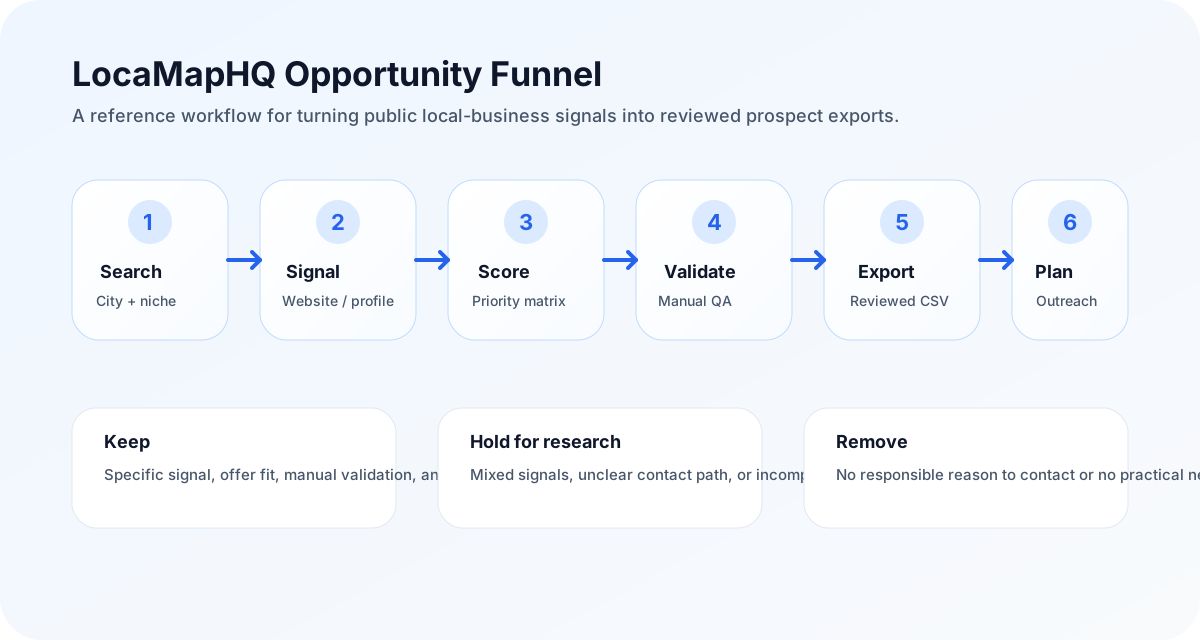
Qualification flowchart
Use this as the review path before a prospect moves from discovery into an outreach-ready export.
Search city + niche
Identify visible signal
Score opportunity
Validate manually
Export reviewed segment
If a business fails any step, keep it in research or remove it. The goal is not maximum export volume; the goal is a list your team can explain and use responsibly.
| Workflow option | Pros | Cons | Best for | Time required | Manual alternative | Automation level | Skill required | Expected outcome |
|---|---|---|---|---|---|---|---|---|
| Manual research | Flexible and easy to start | Slow, inconsistent, and easy to over-export | One small market or a one-off validation pass | Hours per city/niche batch | Maps tabs, website checks, and a spreadsheet | Low | Research discipline and spreadsheet hygiene | A manually reviewed sample list |
| LocaMapHQ workflow | Structured search, saving, notes, scoring, and export | Still needs human qualification and compliance review | Repeatable city, industry, save, review, and export workflows | Minutes to build a candidate batch, plus review time | Recreate the same workflow in Sheets | Medium | Agency targeting and offer-fit judgment | A cleaner qualified prospect segment |
| Custom API workflow | Fits internal systems and custom reporting | Requires technical setup and internal QA | Teams that need prospecting data inside an existing system | Implementation project plus recurring QA | Manual import/export process | Higher, depending on integration | Developer resources and data QA process | A controlled internal prospecting workflow |
When to use LocaMapHQ
Use LocaMapHQ when you need city-and-industry discovery, visible opportunity signals, saved prospects, and CSV export in one workflow.
When not to use it
Do not use it as a guarantee of leads, replies, clients, rankings, revenue, or complete data.
Manual alternative
The manual alternative is map research, website checks, notes, scoring, and export cleanup handled entirely in spreadsheets.
Educational case studies, not customer claims
These examples are realistic training scenarios for agency teams. They are not real customers, results, or performance claims. Use them to teach reviewers how to connect visible signals to a safer next workflow.
Example Plumbing Company
- Initial state
- Active local service company with emergency jobs, several recent reviews, and a thin website with no clear estimate path.
- Website issues
- Mobile page loads slowly, services are grouped onto one generic page, and the quote CTA is buried below the fold.
- Google Business Profile observations
- Public profile appears active, but review recency and service coverage should be checked manually before outreach.
- Why it scores well or poorly
- Scores well on business value and visible website need, but outreach difficulty is medium because emergency-service messaging must be specific and respectful.
- Recommended outreach
- Offer a short website and quote-flow review focused on helping visitors find the right service page and contact path.
- Expected workflow
- Save as web design + conversion review, add a note about mobile CTA clarity, export only after checking the website and contact route.
Example Dental Clinic
- Initial state
- Established clinic with strong reputation signals but thin treatment pages and inconsistent appointment messaging.
- Website issues
- Service pages lack patient-focused explanations, trust proof is scattered, and booking options are not consistently visible.
- Google Business Profile observations
- Review depth may be strong, but category fit, location relevance, and appointment information should be verified.
- Why it scores well or poorly
- Scores well on business value and modernization potential; outreach difficulty is higher because healthcare messaging requires extra care.
- Recommended outreach
- Offer a patient journey and local visibility review rather than promising new patients or rankings.
- Expected workflow
- Save as local SEO + website trust review, verify service pages, and prepare a diagnostic-first message.
Example Roofer
- Initial state
- Seasonal high-value contractor with visible local competition and mixed website quality.
- Website issues
- Project proof is limited, service-area pages are thin, and the request-estimate path is unclear on mobile.
- Google Business Profile observations
- Review count and recency should be compared against nearby competitors before assigning priority.
- Why it scores well or poorly
- Scores high when reviews, service value, and website gaps align; scores lower if contactability or business activity is unclear.
- Recommended outreach
- Offer a service-area and estimate-flow audit with examples from public pages, not a guarantee of leads.
- Expected workflow
- Save as high-value home service segment, compare local competitors manually, then export a small reviewed batch.
Example Restaurant
- Initial state
- Local restaurant with active reviews but an outdated menu experience and inconsistent hours across public references.
- Website issues
- Menu is hard to read on mobile, ordering/reservation paths are unclear, and event or catering pages are missing.
- Google Business Profile observations
- Hours, location, menu links, and review recency need validation because restaurant data changes quickly.
- Why it scores well or poorly
- Scores well for practical modernization if the restaurant is active; outreach difficulty rises if margins or seasonality are uncertain.
- Recommended outreach
- Offer a menu, hours, and mobile conversion cleanup review rather than a broad marketing pitch.
- Expected workflow
- Save as website update segment, verify menu/hours, and use a narrow operational improvement angle.
Example Law Firm
- Initial state
- Professional service firm in a competitive market with unclear intake flow and thin practice-area content.
- Website issues
- Practice pages are generic, attorney trust proof is limited, and consultation CTAs are inconsistent.
- Google Business Profile observations
- Practice area, location, review context, and advertising sensitivity should be manually reviewed.
- Why it scores well or poorly
- Scores high on business value but outreach difficulty is high because legal services require precise, conservative language.
- Recommended outreach
- Offer a trust, intake, and practice-page diagnostic without implying legal marketing guarantees.
- Expected workflow
- Save as professional-services diagnostic, verify practice fit, and keep outreach educational and compliance-aware.
Agency priority playbook
Prioritize first
High-value service categories where the visible problem maps directly to your offer and can be verified quickly.
Keep in research
Businesses with mixed signals, unclear contact paths, stale profile details, or a weak connection between the signal and your offer.
Do not export yet
Records with no specific reason for outreach, uncertain business activity, sensitive claims your team cannot support, or no responsible next action.
Editorial opinion: agencies usually get more reference value from a smaller list with strong notes than a large export that forces generic outreach. The operational advantage is not just speed; it is clearer judgment.
Interactive review checklist
Expand each checkpoint before exporting a segment. This uses native HTML so it works without extra JavaScript.
Daily workflow
Pick one city and one niche, review visible signals, save only records with a specific note, and remove rows that cannot be explained.
Weekly workflow
Compare segments, export only the batch your team can review, prepare compliant messaging, and document what the first outreach pass teaches.
Monthly workflow
Review which niches produced useful conversations, which signals were noisy, and whether scoring rules need to change.
Team handoff
Give the next owner the segment, score, proof point to verify, recommended angle, compliance status, and next action.
Recovery process
If a campaign underperforms, inspect the search criteria, segment quality, message specificity, proof point, and follow-up process before increasing volume.
Downloadable worksheets
These templates are simple CSVs so an agency can use them in Sheets, Excel, Airtable, or a CRM import workflow.
Authority sources to validate with
Use official sources when a page makes claims about search quality, business profiles, speed testing, compliance, or market context. These sources do not replace your own review, but they keep the workflow grounded in reliable references.
Validation checklist before outreach
- The business appears active and relevant to the city/niche being researched.
- The visible signal is specific enough to explain without exaggeration.
- The website, profile, or listing information has been manually spot-checked.
- The offer matches the observed issue and the likely business context.
- The record has a practical next action and a segment label.
- The outreach plan accounts for applicable law, consent, and opt-out expectations.
Assumptions and limitations
- Scores are editorial decision aids, not objective predictions.
- Public business signals can be stale, incomplete, or misinterpreted without manual review.
- Outreach decisions should account for applicable laws, platform rules, consent, and opt-out expectations.
- LocaMapHQ helps organize research; it does not guarantee leads, clients, revenue, rankings, or response rates.
Signals and tradeoffs to review
Information gain comes from the review step. Instead of relying on a single datapoint, compare several signals and decide whether they point to the same opportunity. If they conflict, slow down and keep the record in research instead of moving it directly into outreach.
- Opportunity signal
- Fit score
- Business activity
- Contact path
- Segment label
- Next action
Limitation: A template cannot fix weak targeting. It only makes a strong qualification process easier to repeat. That is why the final decision should stay with a human reviewer who understands the client offer, the market, and the outreach rules.
Mistakes to avoid
- Adding too many columns
- Skipping review status
- Mixing raw and qualified records
- Using templates as a substitute for judgment
Field notes for agency teams
The most useful lists tend to include fewer rows and better notes. A note like “no website listed, 46 recent reviews, high-value emergency service, verify contact page before outreach” is more useful than a spreadsheet with hundreds of businesses and no reason for inclusion. Notes also protect the team from repetitive messaging because each segment has a clear angle.
Review the first exported batch manually before scaling. If more than a third of the records require heavy cleanup, the search was too broad. If every record uses the same reason for outreach, the segment may be strong. If no record has a specific reason, the list should not move into outreach yet.
For deeper context, pair this guide with the complete website audit checklist, the local SEO audit checklist, and the prospecting tracker template. If the workflow fits your team, review pricing and credits or create an account to try the local prospecting workflow.
Sources and editorial notes
These references support the article’s approach to people-first content, public business research, platform policy awareness, and safer agency workflows.
- Google Search Central: creating helpful, reliable, people-first content — Used as the editorial standard for usefulness, originality, and reader-first structure.
- Google SEO Starter Guide — Supports clear titles, descriptions, crawlable links, and helpful page organization.
- U.S. Census Business Dynamics Statistics — Useful context for small-business market research and business formation trends.
Related guides, templates, and next steps
Checklists and templates
Money pages
Learn pages and resources
When the research direction is clear, move naturally from education to action: run a focused search, qualify the saved businesses, export the reviewed segment, and compare the workflow against your current spreadsheet or manual research process.
Key takeaways
- Start with a focused market, offer, and visible signal instead of a broad export.
- Use the decision frame: Every field should help the team decide save, review, segment, contact, or discard.
- Document why each business stayed on the list so outreach can stay specific and respectful.
- Keep human review in the workflow; prospecting signals do not guarantee replies, revenue, rankings, or clients.
Recommended next workflow
Use this article to build one reviewed prospecting batch: choose a market, identify the visible signal, save only relevant businesses, add notes, and export the segment your team can act on this week. For this topic, the recommended decision frame is: Every field should help the team decide save, review, segment, contact, or discard. The common mistake is exporting too early and forcing outreach to fix weak qualification.
LocaMapHQ helps organize local business research and exports. It does not guarantee performance outcomes, and your team should still review fit, compliance, offer, and messaging before outreach.
Why use LocaMapHQ here?
It keeps the search, save, qualification notes, and CSV export workflow in one place so the team is not rebuilding the same spreadsheet process every week.
Who benefits most?
agency operators building reusable prospecting checklists, worksheets, and list templates who already know their offer and need a cleaner way to research local markets.
When should you stay manual?
Use a manual spreadsheet first if you are still defining your ICP, testing one tiny market, or need a one-off research pass.
What happens after export?
Review the CSV, remove weak-fit records, segment the list, prepare compliant messaging, and track what your team learns from the campaign.
Related local lead guides
Frequently asked questions
These FAQs focus on agency workflow, local prospecting decisions, Google Maps research considerations, CSV export planning, and the limits of public business signals.
What is the best way to use local lead generation checklist for agencies?
Use local lead generation checklist for agencies as part of a focused prospecting workflow: pick one city, one industry, one opportunity signal, then review each lead before outreach.
Can LocaMapHQ guarantee leads or clients?
No. LocaMapHQ helps find and organize possible local business opportunities, but outcomes depend on targeting, offer, market, outreach, timing, and follow-up.
Should I export every result?
No. Export only the prospects that match your criteria and are ready for review or outreach. Smaller qualified lists are easier to use than large unfiltered exports.
How often should agencies build local lead lists?
Many agencies build small weekly batches. A weekly cadence keeps prospecting manageable and helps prevent stale lists.
What should I check before outreach?
Review website status, business category, city fit, review count, rating, contact availability, and whether your offer is relevant to the business.